
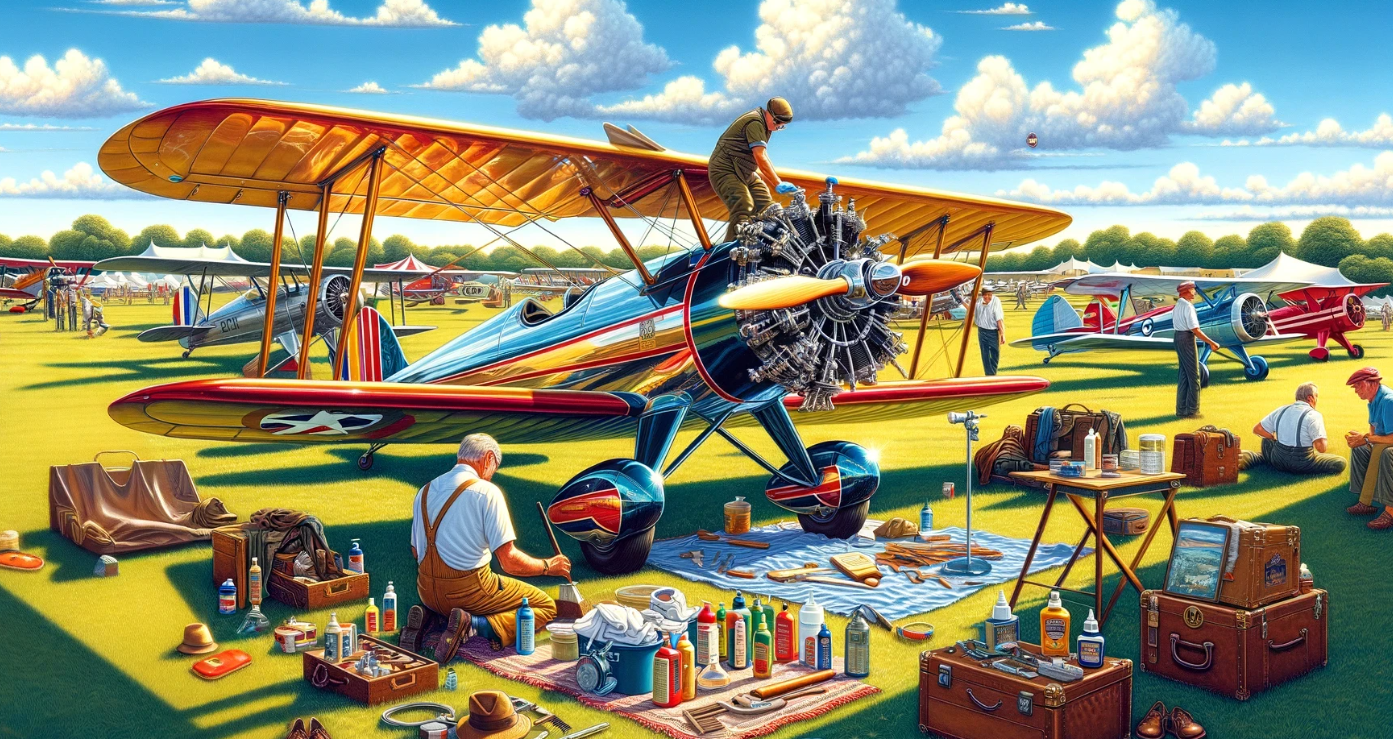
As I finished up my second year of showing airplanes at a couple of the larger fly-ins, I was reflecting on what I’ve learned and thought I’d pass that along for whatever it may be worth to another neophyte.
Tips, Tricks & Tools
I walked up to a former Sun N Fun Grand Champion Fairchild PT 19 after getting my plane tied down on Monday. It looked better than brand new, and I asked the owner if he actually flew it because it was so perfect. He said, “Not much, I mostly like looking at it”.
Perfection is everyone’s goal, especially if you are trying to win an award here or at AirVenture. But I actually like to fly my airplane(s) so keeping them perfect isn’t really an option. Here’s how I get as close as I can.
Preparation:
First impressions are important! A judge told us last week that the attention to detail on my plane was the best they’d seen. Let’s hope that means a trophy! While we wait…
Shiny paint is important. I had Jamie Lyon’s buff my 15-year-old paint last year. He’s a real pro and when he finished it looked almost flawless. Let me know if you’d like his contact info. He travels the country working on amazing airplanes. To maximize the time the finish would stay beautiful, and to make it easier to keep clean, I had Jamie do a ceramic coating as well.
The most important thing is clean! I use Johns 360 Coating products to clean and polish. https://johns360coatings.com/. After flying, and during a fly-in, I use John’s Decon Spray to remove grease, oil, and dirt especially where I get exhaust oil or residue which is after every flight with a radial engine! I use his Water Spot Remover if there are spots from dew or rain then Mint Ceramic Waterless Car Wash with NEW polyfiber cloths to clean the paint. I finish off with a Super Blue Speedcoat as a wetting polish. Apply with one cloth which can get wet being careful to turn over frequently so as not to scratch the paint. I use another cloth, which must be dry to buff.
Before moving on to other areas I touch up any nicks I find with paint and these touch-up sticks from Aircraft Spruce: https://www.aircraftspruce.com/catalog/ … ey=8545522.
Sometimes exhaust residue doesn’t want to come off so I try John’s Decon spray first followed by Correction Compound or the finest grade of Nuvite polish Nushine IIS https://bd2eaa.a2cdn1.secureserver.net/ … eIIWeb.pdf. I use a rag if possible but I will resort to my Rupes Ibrid Mini Polisher if needed: https://rupesusa.com/hlr75-ibrid-mini-polisher/. This thing is powerful and batteries last 30 minutes so you can do a lot of work without having to go look for somewhere to plug in the battery charger. It’s also small and lightweight so I can carry it easily in the turtledeck of a biplane.
Speaking of the Rupe polisher, it’s a great tool to use in polishing a metal propeller to a blazing mirror shine! I use a couple of different Nuvite compounds depending on how long it’s been and work up progressively. I go slow and buff off the black stuff routinely as I don’t want to over-polish.
Sometimes you need to cover more ground, need more power, etc. and Rupe’s Cyclo Polisher with dual heads is a beast of a machine but useful: https://rupesusa.com/cyclo-toolmakers/.
When the engine gets dirty a siphon rig and air compressor along with mineral spirits get the dirt and most of the oil. I used to do this with rags, Q tips and spray bottles until someone showed me the easy way! Sometimes mineral spirits aren’t enough, and it takes Acetone and a lot of rubbing. At a show, careful cleaning with Decon spray and a clean rag gets the job done well. Oil does get baked on to bright work unfortunately and chemicals won’t get it off. So I use Nuvite and a Griot’s Garage G8 with a 2-inch head: https://www.griotsgarage.com/g8-mini-ra … -polisher/.
The key to getting ready and getting clean is to go over every part of the plane carefully and on a biplane there’s a lot of stuff to clean! I don’t forget the windscreens which I use Pledge on, the seats with a quick coat of leather balm of some kind, or the instrument panels and instruments for which Q tips are invaluable. While doing all of this cleaning and polishing I keep wrenches and screwdrivers handy because there are always loose screws and bolts on a vibrating machine.
At the Fly-In:
Now that everything’s clean I need to keep it that way which is going to be a challenge. I need to keep it neat and organized in the turtle deck, so the judges won’t have a problem with that area when they look. So, I use plastic containers to hold everything. One carries the little Rupe polisher, batteries, charger, and clean pads. Another has a fresh bottle of Decon Spray, the car wash, and Speedcoat. I bring lots of NEW poly fiber cloths, about a half dozen red shop rags, and a half dozen white shop towels.
Every morning the entire plane is going to need to be wiped down from dew (or rain!). The very best tool I’ve found for this is a California Jelly Blade: https://www.calcarcover.com/product/the … blade/1224. This thing is amazing! Used carefully with a new poly fiber rag and the paint looks awesome!
The top of the top wing though is tough. So, I use about 5 sections of a lightweight pole with a squeegee on the end to pull the water off the wing. I can then use a dry mop head to get the streaks.
To keep the cockpit clean overnight I use a cockpit cover from Bruce’s Covers: https://www.aircraftcovers.com/.
To keep the rudder, elevators, and ailerons from flopping around I use gust locks from Air Gizmos and World Pilot Supplies: https://worldpilotsupplies.com/collecti … 5451974721.
I carry The Claw tie-down kit but it’s useful to replace the hammer because the one supplied isn’t well made. You also need to precut the ropes and melt the ends or they look sloppy. Available all over the place you can get it here: https://www.sportys.com/the-claw-aircra … n-kit.html. Be sure to bring some poly fiber rags to keep the ropes off any painted surface!
The Book:
At Airventure you get points for having a well-organized book on the history and restoration of the plane. At Sun N Fun it’s not required but really helpful. I got into a discussion with a judge this week about whether or not my plane originally had a front windscreen. I pulled out the build sheet (in the book) to show original equipment and then brought up a delivery photo from the National Waco Club website to show how it looked on June 6, 1934, and we compared that to the plane. Issue resolved! The book should document as much as possible with lots of photos. I use a spiral comb bound book because it’s lighter, more compact and more professional than a three ring binder. I bring two copies in case more than one judge at a time wants to see one.
That’s pretty much it. I’m new at this and still learning. But that’s what I do to get ready.
Written By
Tony Caldwell

Leave a Reply